
HomeLearn
Know what's on your plate
"Farm fresh" is printed on a lot of boxes. Here's what the labels actually mean, what the studies actually measure, and why we farm the way we do, so you can judge for yourself.
The labels, decoded
Caged vs free-range vs pasture-raised
Three labels, three completely different lives for the hen, and three different eggs.
| Caged | Free-range | Pasture-raised How we farm | |
|---|---|---|---|
| Living space | A battery cage, with less floor space per hen than an A4 sheet of paper | Indoors in sheds, with some access to an outdoor area | Open pasture with trees, soil and sky, every single day |
| Daily life | No movement, no sunlight, no natural behaviour | Mostly indoors; outdoor time is limited and crowded | Foraging, dust-bathing and perching. Natural hen behaviour |
| Feed | Commercial feed, often with additives to push production | Commercial feed, sometimes with grains | Foraged greens and insects + fresh-cut greens and grains |
| The egg | Pale yolk, weak shell, flat taste | Somewhat better than caged | Golden yolk, firm white, strong shell, rich flavour |
| Breed | High-output commercial layers | Commercial layers | Hardy desi breeds, raised at nature's pace |
The measurable difference
What lab tests keep finding
Independent studies, including Penn State University research and the Mother Earth News egg testing project, compared pasture-raised eggs with commercial caged eggs:
Sources: Pennsylvania State University pastured-poultry research; Mother Earth News egg testing project. Values are averages across tested farms; individual eggs vary naturally.
The other side of the story
What ordinary commercial chicken hides
We're not here to scare you. These are published findings about how most commercial chicken in India is raised.
Antibiotic residues in 40% of samples
A Centre for Science and Environment (CSE) study of chicken sold in Delhi-NCR found antibiotic residues in 40% of samples, and 17% carried more than one antibiotic. Routine antibiotic use in poultry is a known driver of antibiotic resistance in humans.
Full grown in just 40 days
Commercial chickens are bred and fed to hit full weight in just 40 to 47 days, a pace their legs and hearts often can't keep up with. Desi birds take months to grow, and it shows in the texture and taste.
Less space than this page
In battery-cage egg farming, each hen lives her whole life with less floor area than a sheet of A4 paper. No sunlight, no soil, no movement. That stress ends up in the food.
Sources: CSE Pollution Monitoring Lab study, "Antibiotics in Chicken" (Delhi-NCR); standard commercial chicken growth cycles; battery-cage space allowances documented by animal-welfare bodies.
Why desi breeds
The breed your grandmother would recognise
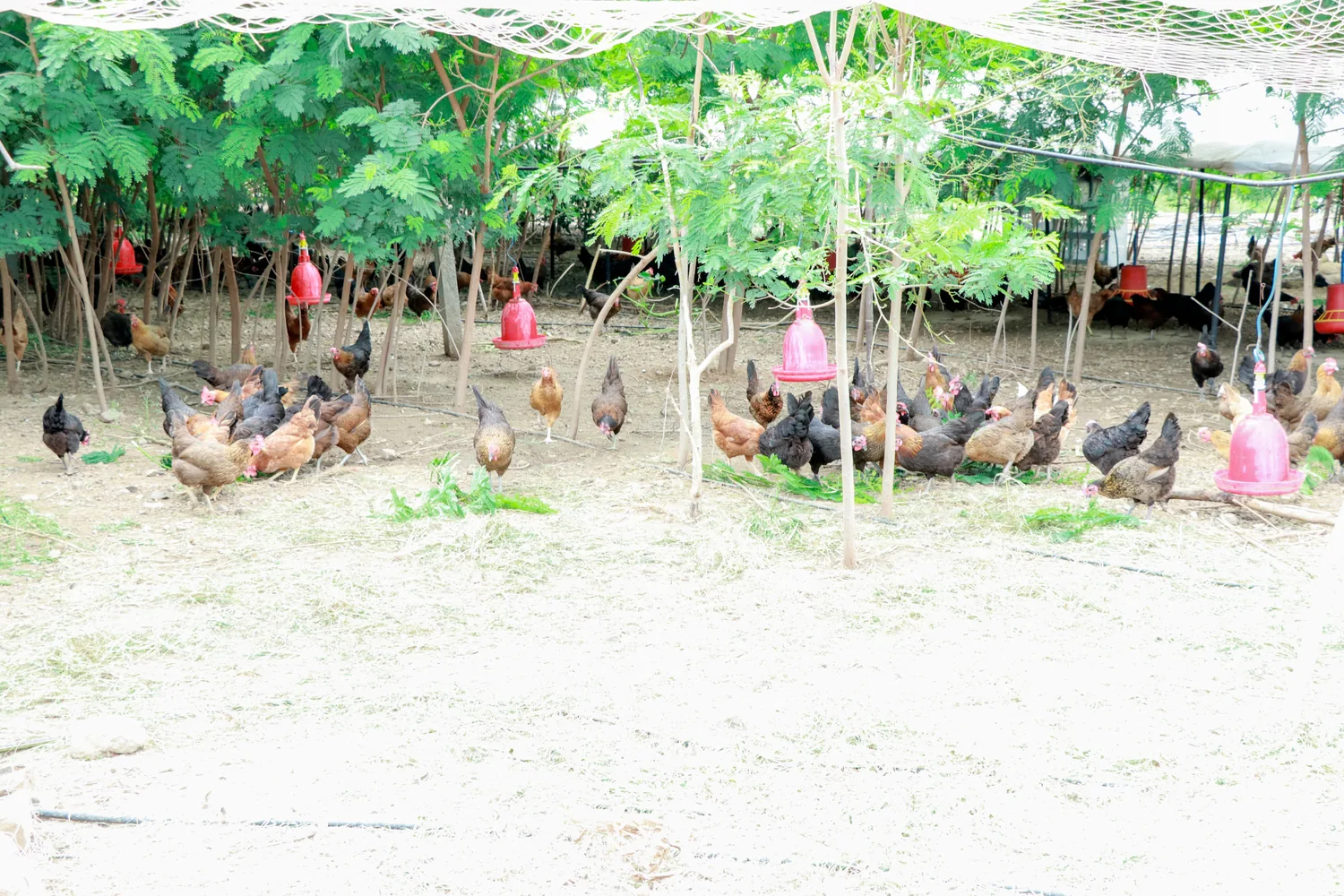
Desi (native) breeds grow slower and lay fewer eggs than commercial hybrids. That's exactly the point. They're naturally hardy, so they don't need routine antibiotics. They thrive outdoors, so they don't need cages. And their eggs and meat carry the deep flavour that fast-grown birds simply never develop.
- Naturally disease resistant, with no routine medication
- Suited to open-pasture life in the Indian climate
- Eggs in natural shades of white, cream and brown
- Firmer, tastier meat with less fat
Good to know
Questions we hear a lot
What does “pasture-raised” actually mean?
It means our hens live outdoors on open ground, not in cages (like most commercial eggs) and not just “with outdoor access” (like many free-range farms). They scratch the soil, chase insects and dust-bathe every single day. It's the oldest way of keeping hens, and still the best.
Why do the eggs vary in size and colour?
Because they come from real desi hens, not a production line. White, cream or brown, the variation is natural and a sign that nothing artificial is standardising the flock. The taste is wonderfully consistent though: rich, with a firm golden yolk.
How fresh are the eggs, and how should I store them?
Eggs are collected and packed on the same day at the farm. They're best consumed within 20 days of the packing date printed on the box, stored in the refrigerator at 4°C.
Is the chicken fresh or frozen?
Our desi chicken is pre-cut, vacuum-packed and frozen at -18°C within hours of processing, which locks in freshness without any preservatives. Thaw it in the fridge for 6-8 hours (or in cold water for 30-60 minutes), and don't refreeze once thawed.
Are your products certified?
Yes. We're FSSAI licensed (Lic. No. 11524088000178) and ISO certified. Every pack carries the packing date, batch number and full traceability back to our farm in Laul.
Can I visit the farm?
We'd love that. Just give us a call at 97303 12202 before you come, so someone's free to show you around.
Taste the difference the numbers describe
Pick up a pack at a store near you, or ask us anything on WhatsApp.